
Churchill War Rooms
The underground rooms from which Churchill's government ran the Second World War, kept as they were, with a museum of his life alongside. Entry is by timed ticket; book ahead.
London rewards a plan that keeps each day in one part of town, because the distances between its famous sights are bigger than the map suggests. This plan does Westminster and Trafalgar Square on the first day and ends on the London Eye. The second day starts at the Tower of London and follows the river west through two markets to Tate Modern. The last day starts in the British Museum and finishes in Kensington, with a palace and a long walk in Hyde Park. Four of the twelve stops are among the city's great free museums.
Updated October 2026
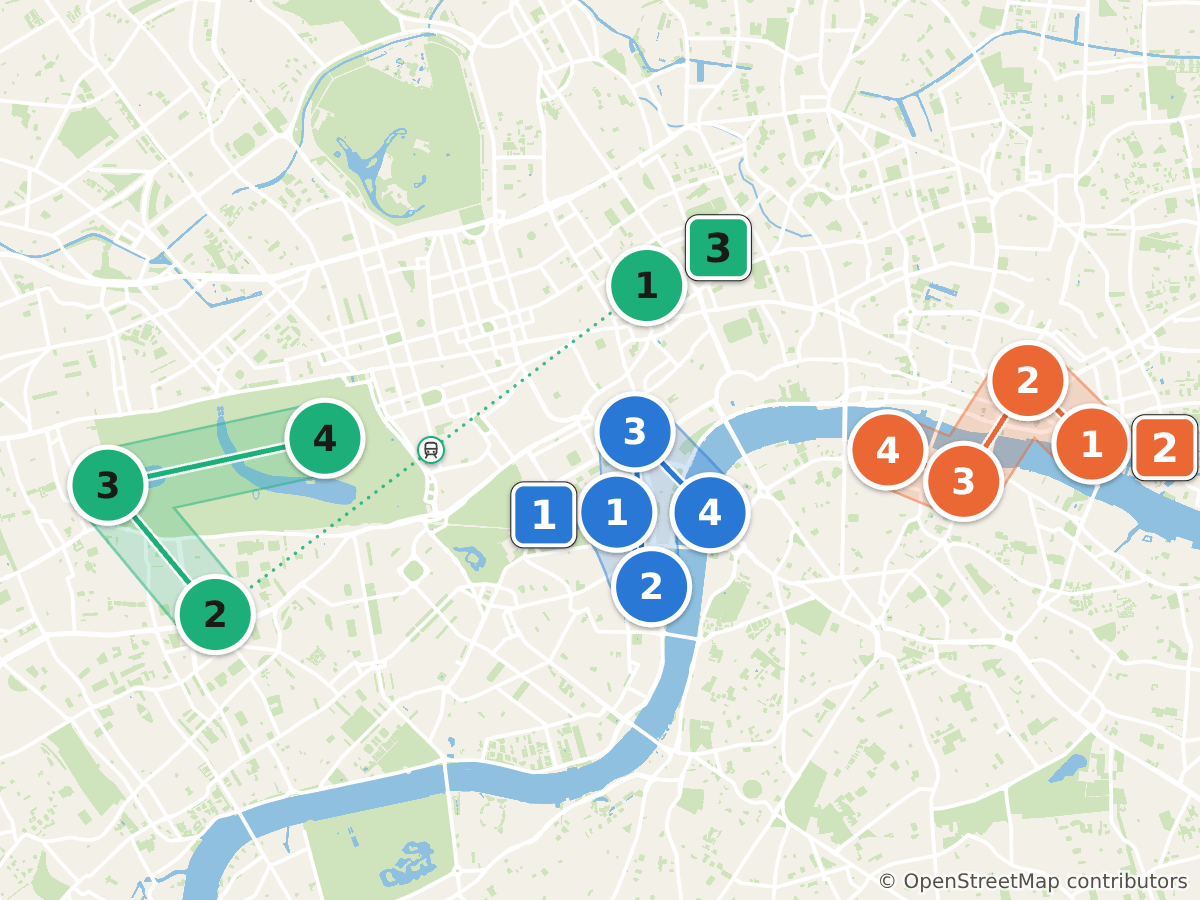
Solid line: on foot · Dotted line: a ride (train, bus, boat or taxi) · Each day's stops are numbered from 1.
Map data © OpenStreetMap contributors
Why this orderStart underground at the Churchill War Rooms on an early timed ticket. Westminster Abbey is a few minutes' walk away; book it too, because it closes to sightseers on some days for services. Walk up Whitehall to Trafalgar Square for the National Gallery, free, and choose a few rooms. Finish by crossing the river on the Golden Jubilee footbridges to the London Eye, booked for the end of the afternoon, with Westminster across the water.
Getting aroundOn foot all day. Westminster Abbey to Trafalgar Square along Whitehall is under 20 minutes on foot, and from there the footbridges bring you to the Eye in about a quarter of an hour.
The underground rooms from which Churchill's government ran the Second World War, kept as they were, with a museum of his life alongside. Entry is by timed ticket; book ahead.
The coronation church since 1066, with royal tombs and Poets' Corner. Sightseeing needs a ticket, and booking ahead is strongly advised.
More than 2,300 paintings from the 13th century to about 1900, facing Trafalgar Square. The collection is free; pick a few rooms rather than the whole map.
The 135-metre observation wheel on the South Bank, looking straight across at Westminster. Book a timed ticket for late in the day.
If it rains: Trade the London Eye, whose views shrink in low cloud, for the National Portrait Gallery next door to the National Gallery, free and reopened after a long renovation.
Why this orderBe at the Tower of London when it opens and go straight to the Crown Jewels, before the queue builds towards midday; join a Yeoman Warder tour afterwards. Walk up into the City to Leadenhall Market, a Victorian covered market, then cross London Bridge to Borough Market for lunch. Spend the afternoon at Tate Modern, free, and finish by walking out onto the Millennium Bridge, with St Paul's dome straight ahead.
Getting aroundOn foot all day. The Tower to Leadenhall Market is about a quarter of an hour on foot; Leadenhall to Borough Market, across London Bridge, is under 20; and Borough Market to Tate Modern along the river is under 20.
William the Conqueror's fortress, with the Crown Jewels in the Jewel House and Yeoman Warder tours included in the ticket. See the Jewels first, then everything else.
A covered market whose trade goes back to the 14th century, under a painted iron-and-glass roof of 1881. Free to walk through on the way from the Tower to the river.
One of London's oldest and largest food markets, under the railway arches by Southwark Cathedral; by its own account it goes back to 1014. Come hungry and eat as you go.
Modern and contemporary art in the former Bankside Power Station, entered through the vast Turbine Hall. The collection is free, and the café on Level 10 looks out over the city.
For the river view: Trade Leadenhall Market for Tower Bridge, next to the Tower: the Tower Bridge Exhibition takes you along the high-level walkways, with glass floors over the road and river. Then cross the bridge and follow the south bank west to Borough Market.
Why this orderOpen the day at the British Museum with a free timed ticket, and see the Rosetta Stone and the Parthenon sculptures first. Take the Piccadilly line west to South Kensington and walk through the old pedestrian subway to the Natural History Museum. Then walk north into Kensington Gardens for Kensington Palace, where Queen Victoria was born, and end the trip with a long walk east along the lake into Hyde Park.
Getting aroundPiccadilly line from Russell Square or Holborn to South Kensington, then the pedestrian subway to the museums. The Natural History Museum to Kensington Palace is under half an hour on foot.
The world's first public national museum, founded in 1753, home of the Rosetta Stone and the Parthenon sculptures. Free; booking a free time slot is advised but not required.
Alfred Waterhouse's cathedral-like museum, where the skeleton of a blue whale hangs over the main hall. Free; a free ticket guarantees entry.
The palace in Kensington Gardens where Queen Victoria was born and grew up, now open to visitors with a ticket.
One of London's Royal Parks, free and open, with the Serpentine lake running through it and Speakers' Corner at its north-east corner. A long, easy walk to end on.
If it rains: Trade Hyde Park for the V&A, next to the Natural History Museum: free, and the world's largest museum of applied and decorative arts and design.
They change by place and season; Westminster Abbey also closes to sightseers on some days for services and state events. Check each place before you go, and book a time slot wherever one is offered.
Paid and timed: the Churchill War Rooms, Westminster Abbey, the London Eye, the Tower of London and Kensington Palace. Free but worth a free time slot: the British Museum and the Natural History Museum.
Tap a contactless bank card or an Oyster card on the Tube and buses; both pay the same fares and are capped each day. Paper tickets cost more.
The Elizabeth line, the Piccadilly line and the Heathrow Express all link the airport with central London.
A base around Covent Garden or Bloomsbury keeps Day 1 and the British Museum on foot, and puts you on the Piccadilly line for South Kensington.
Enough for the main royal and historic sights and three of the great museums, as long as each day stays in one area. It is not enough to add Windsor or Greenwich without dropping a day here.
The National Gallery, Tate Modern, the British Museum and the Natural History Museum, plus the National Portrait Gallery and the V&A on the swaps. Special exhibitions may charge.
The Churchill War Rooms, Westminster Abbey, the London Eye, the Tower of London and Kensington Palace. For the free British Museum and Natural History Museum, a free time slot saves queuing.
The queue for the Jewel House builds towards the middle of the day, so seeing them at opening frees the rest of your visit.
Only for a period in summer, when the State Rooms open to visitors. The Changing of the Guard follows a published schedule and can be cancelled at short notice, for example in wet weather, so check the official schedule before planning around it.
Place names from Google Maps.
Copy this plan into your own trip notebook. Change anything, add dates later, and invite the people you are travelling with.
Use this plan
By continuing, you agree to the Terms of Service and acknowledge the Privacy Policy.