
Notre-Dame Cathedral, Paris
Reopened after the 2019 fire, with its stone and glass cleaned to a brightness few visitors had seen before. Entry is free; an optional free time slot can shorten the wait.
Three days is enough to see the Paris most people picture, as long as you stop crossing the city back and forth. This plan gives each day one part of town and walks it in an order that saves your legs: the two islands and the Latin Quarter first, then the Louvre and the old streets of the Marais, and finally Montmartre in the calm of the morning, with the Eiffel Tower kept for the last evening. Two of the big visits run on booked time slots, so the days are built around those and still leave room for a long lunch.
Updated October 2026
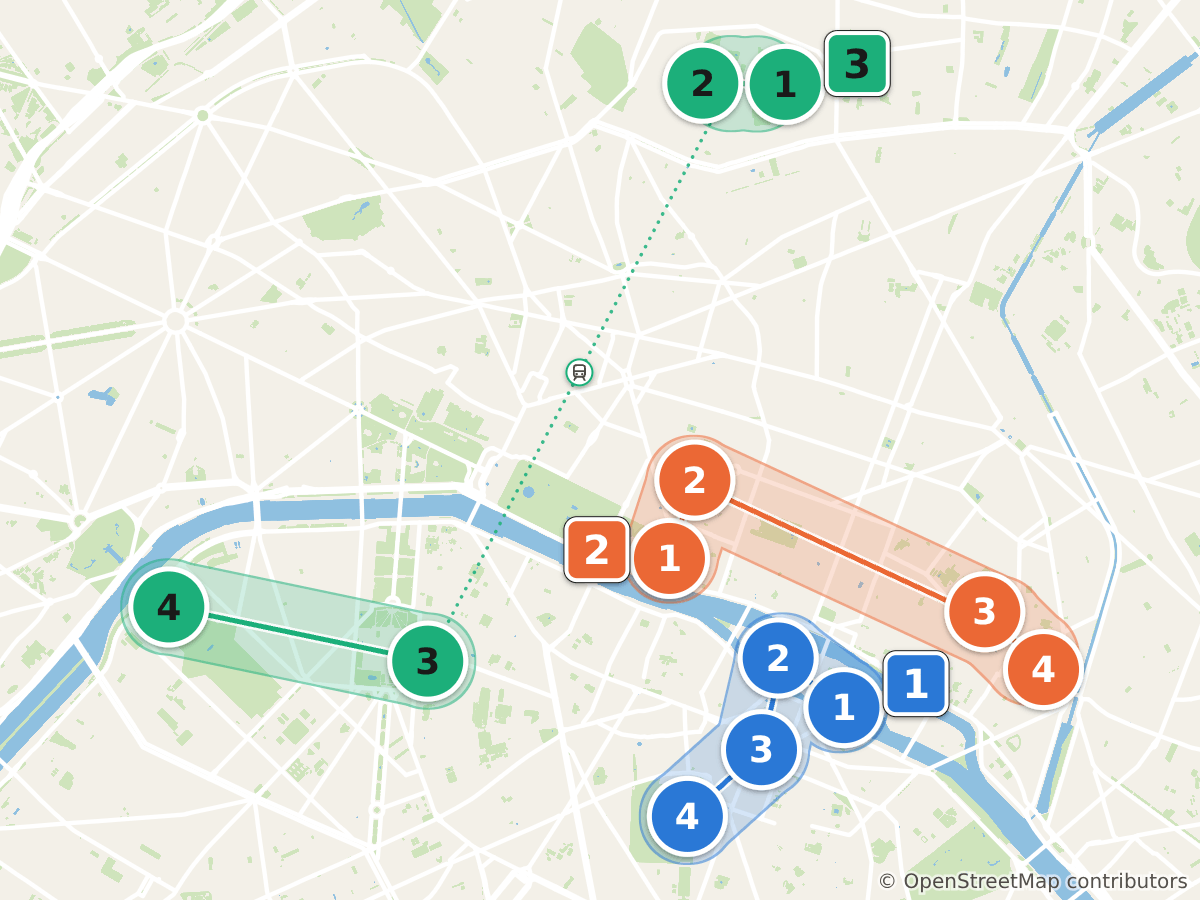
Solid line: on foot · Dotted line: a ride (train, bus, boat or taxi) · Each day's stops are numbered from 1.
Map data © OpenStreetMap contributors
Why this orderStart at Notre-Dame as it opens, when the free queue is shortest and no booking is needed. Sainte-Chapelle, two minutes away, runs on booked time slots, so book a late-morning slot and the cathedral never has to be rushed. Then cross the small bridge to the Left Bank: the Musée de Cluny is a short walk uphill, and the Luxembourg Gardens a little further on, the right place to sit down after a morning on your feet.
Getting aroundOn foot all day. Notre-Dame to the Luxembourg Gardens is under 20 minutes on foot without stops.
Reopened after the 2019 fire, with its stone and glass cleaned to a brightness few visitors had seen before. Entry is free; an optional free time slot can shorten the wait.
A royal chapel whose upper level is almost all stained glass, reached by a narrow stair from a low, dark lower chapel. Give your eyes a minute at the top: it is one of the most striking interiors in the city.
France's museum of the Middle Ages, in a medieval abbots' residence built beside the remains of Roman baths. The six Lady and the Unicorn tapestries are the reason to come, shown together in a dim room of their own.
The Senate's formal garden, with gravel walks, the Medici Fountain and green metal chairs you are free to pull up wherever you like. Finish the day here, then walk to Saint-Germain for dinner.
If it rains: Trade the gardens for the Panthéon, five minutes away: a domed neoclassical monument whose crypt holds Voltaire, Victor Hugo and Marie Curie.
Why this orderThe Louvre is the one visit on this trip that has to be booked well ahead, and the earliest slot gives you the galleries before the crowds build. Pick a wing instead of trying to see it all. Lunch next door in the Palais-Royal garden, then head east into the Marais, where the city history museum is free to walk into and Place des Vosges, the oldest planned square in Paris, is at its best in the late-afternoon light.
Getting aroundWalk east along Rue de Rivoli to the Marais in about half an hour, or take metro line 1 from Palais-Royal–Musée du Louvre to Saint-Paul.
The former royal palace that became the world's most visited museum. Book the first slot, choose two or three collections before you arrive, and leave when your attention runs out rather than when the map does.
A walled garden of clipped trees behind the Palais-Royal, with the striped Buren columns in its front courtyard. A quiet place to sit and eat a few minutes from the museum.
The museum of the history of Paris, spread across two Marais mansions, from prehistoric canoes to old shop signs and Proust's bedroom. The permanent collection is free and needs no booking.
Matching red-brick houses over stone arcades, laid out in the early 1600s around a garden of trees and fountains. Walk the arcades, then find a terrace nearby as the day winds down.
For a covered lunch: Skip the Palais-Royal, take metro line 1 straight to the Marais, and eat at the Marché des Enfants Rouges, a small covered food market.
Why this orderMost visitors climb Montmartre for sunset; this plan goes up in the morning, when the steps and the square are calm. Then cross the city by metro to the Musée Rodin, whose garden makes an easy middle of the day, and walk through the Champ de Mars to the Eiffel Tower for the evening, when it lights up and sparkles for a few minutes each hour after dark.
Getting aroundMetro line 12 from Abbesses, changing to line 13 at Saint-Lazare for Varenne, next to the Musée Rodin. From there the Eiffel Tower is about half an hour on foot.
The white-domed basilica at the top of Montmartre, with one of the widest free views over Paris from its front steps. Come early and the steps are almost yours.
The small square behind the basilica where painters set up their easels among café tables. Wander the lanes around it before the tour groups arrive.
Rodin's sculpture in the mansion where he worked and in its garden, where The Thinker sits outdoors among the roses and trees. On a fine day the garden alone is worth the stop.
Built for the 1889 World's Fair and still the city's signature. Book a time to go up in advance, especially for the summit, and stay nearby after dark for the lights.
If it rains: Trade the Rodin garden for the Musée d'Orsay, by the river, home of the great Impressionist collection in a former railway station.
They change by place and season, and several museums close one day a week. Check each place before you go, and book a time slot wherever one is offered.
The Louvre requires a timed booking for every visitor, including those who enter free, and popular slots go weeks ahead. Sainte-Chapelle also runs on time slots. Book the Eiffel Tower ahead if you want the summit. Notre-Dame is free, and its time slot is optional.
The metro is the quickest way between areas. Paper tickets have been phased out: load single Metro-Train-RER tickets onto a Navigo Easy card or a phone. Airport journeys need a separate airport fare.
Charles de Gaulle is linked to the centre by the RER B train; Orly by metro line 14. Both need an airport ticket; the standard Metro-Train-RER ticket does not cover the airports.
A base in the Marais or the Latin Quarter keeps Days 1 and 2 on foot and puts Montmartre and the Eiffel Tower a single metro change away.
Enough for the classic sights at a comfortable pace, if each day stays in one area as it does here. It is not enough to add day trips without dropping something.
The Louvre (required for everyone) and Sainte-Chapelle (time slots). Book the Eiffel Tower ahead for the summit. Notre-Dame, the Carnavalet history museum, the gardens and Sacré-Cœur need no tickets.
Not without losing a day of this plan. The palace and gardens take most of a day including the train, so Versailles fits better in a longer stay.
Probably not. It covers the Louvre, Sainte-Chapelle, the Musée de Cluny and the Musée Rodin (and the Musée d'Orsay and Panthéon swaps), but not the Eiffel Tower, and seven of the stops are free anyway. Add up the paid tickets you will actually use before buying one. You still need to book a Louvre time slot with a pass.
The square and the basilica steps are far quieter early, and it frees the evening for the Eiffel Tower lights on your last night.
Place names from Google Maps.
Copy this plan into your own trip notebook. Change anything, add dates later, and invite the people you are travelling with.
Use this plan
By continuing, you agree to the Terms of Service and acknowledge the Privacy Policy.