
Sight
Plaza Mayor, Madrid
The arcaded main square of Habsburg Madrid, closed in on all sides by matching houses with balconies. Walk through the arches, then cut down the lanes to the south for the old town.
One week is enough for Madrid and the two great cities of Andalusia if you stay on one high-speed rail line and resist adding Barcelona. This plan gives Madrid two days, one for the old royal centre and one for the art museums along the Paseo del Prado, then a day trip to Toledo. The train south stops at Córdoba for a day and a night around the Mezquita. Seville gets the last three days: the river and Triana first, then the Alcázar and the cathedral, and a slower final day in the quieter north of the old town.
Updated November 2026
Madrid → Toledo → Córdoba → Seville
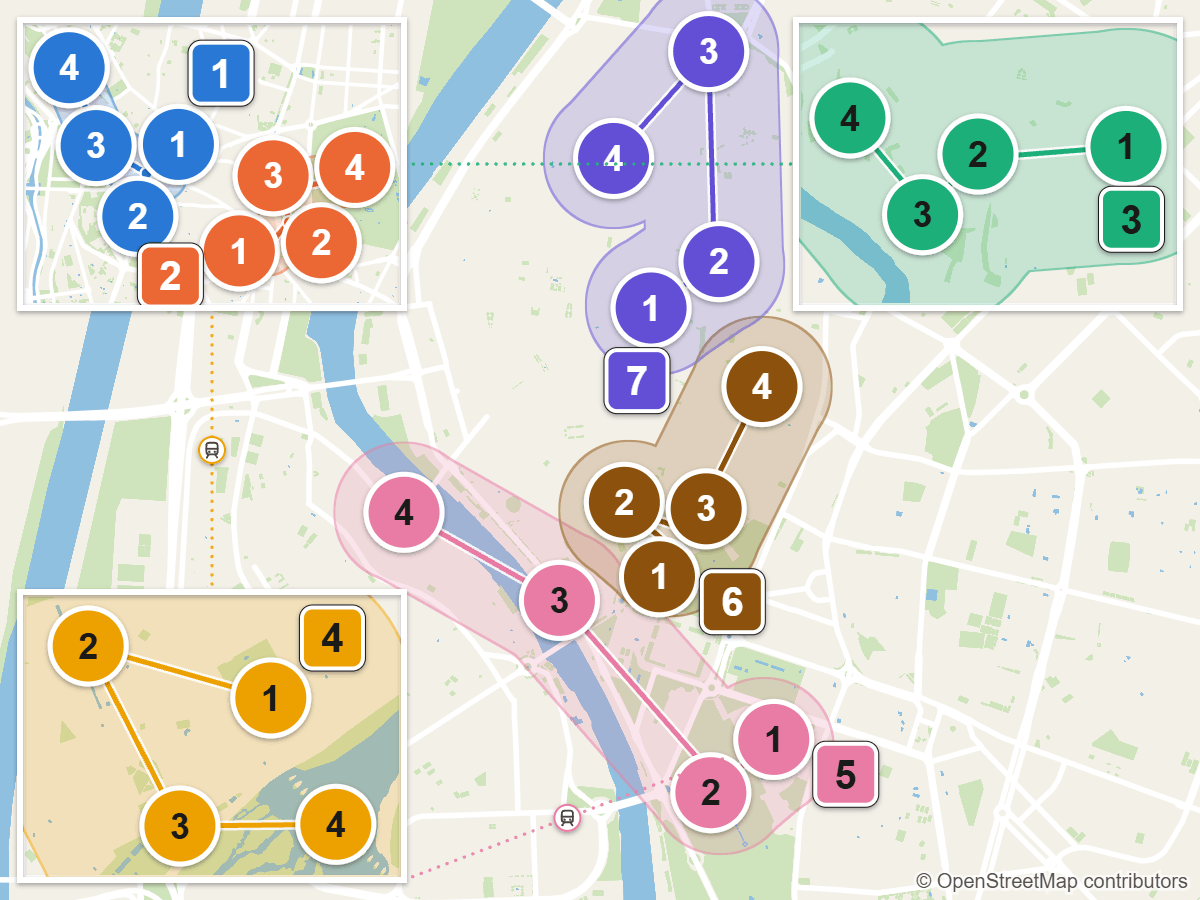
Solid line: on foot · Dotted line: a ride (train, bus, boat or taxi) · Each day's stops are numbered from 1.
Map data © OpenStreetMap contributors
Why this orderStart in Plaza Mayor before the café tables fill, then step into the Mercado de San Miguel next door for an early lunch of tapas. Take a booked early-afternoon slot at the Royal Palace, which can close at short notice for state events, so check the day before. Finish at the Temple of Debod, an Egyptian temple on a ridge to the west, where Madrid comes to watch the sun go down.
Getting aroundOn foot all day. The Mercado de San Miguel is next to Plaza Mayor; the Royal Palace is under fifteen minutes on foot from the market, and the Temple of Debod about twenty minutes from the palace.
The arcaded main square of Habsburg Madrid, closed in on all sides by matching houses with balconies. Walk through the arches, then cut down the lanes to the south for the old town.
An iron-and-glass market hall opened in 1916, now given over to tapas and wine counters. Easiest before the lunch rush, when you can find a place to stand.
The official residence of the Spanish royal family, used today for state ceremonies. The visit runs through the grand state rooms; book a timed slot on the palace's official site.
A temple from the second century BC, given to Spain by Egypt for its help in saving the Nubian monuments, and rebuilt here stone by stone. Free to see from outside, and at its best at sunset.
If it rains: Trade the Temple of Debod for the Royal Collections Gallery beside the palace, opened in 2023 to show the treasures of the Spanish crown.
Why this orderBegin at the south end of the Paseo del Prado with Picasso's Guernica in the Reina Sofía, while the gallery is quiet. Walk north through the terraced Botanical Garden to the Prado, and give it the middle of the day: Velázquez's Las Meninas, Goya and Bosch are the reason to come. Then cross into the Retiro and let the park's lake and glass palace end the day slowly.
Getting aroundOn foot all day. The Reina Sofía to the Botanical Garden is about fifteen minutes along the Paseo del Prado; the Prado is next to the garden, and the Retiro is across the street behind the museum.
Spain's national museum of modern art, in a former hospital by Atocha station. Guernica, Picasso's response to the bombing of the town in the Civil War, is the room most people come for.
The royal botanical garden, laid out on three terraces in the 1770s and 1780s, partly by Juan de Villanueva, the architect of the Prado building next door. A cool, quiet walk between two big museums.
One of the great collections of European painting, strongest in Velázquez, Goya and El Greco, with Bosch's Garden of Earthly Delights. Choose a few rooms rather than the whole building.
A former royal park, open to the public since the 19th century, with a boating lake and the Palacio de Cristal, a glass and iron pavilion from 1887 that now holds exhibitions.
If it rains: Trade the Retiro for the Thyssen-Bornemisza museum, across the Paseo del Prado, a collection that spans the centuries between the Prado's old masters and the Reina Sofía's moderns.
Why this orderTake a morning train and go straight to the cathedral, the largest single visit of the day. Then walk downhill through the lanes, in an order that saves your legs: El Greco's most famous painting in Santo Tomé, the medieval synagogue of El Tránsito, and the monastery of San Juan de los Reyes at the far edge of the old town, before heading back to the station for Madrid.
Getting aroundHigh-speed train from Madrid-Puerta de Atocha to Toledo, then a city bus or taxi up to Plaza de Zocodover. On foot in the old town: each stop is a short walk from the last. From San Juan de los Reyes, walk down or take a taxi back to the station for the train to Madrid.
A great Gothic cathedral whose sacristy works as a picture gallery, led by El Greco's Disrobing of Christ. Allow the longest visit of the day here.
A parish church visited for one painting: El Greco's Burial of the Count of Orgaz, in which two saints come down to lay the count in his tomb.
One of the best-preserved medieval synagogues in Europe, with carved plaster walls, now home to the museum of Sephardic Jewish history.
A monastery built by Ferdinand and Isabella after the battle of Toro in 1476 and first meant as their burial place. Its cloister is the quiet end of the day.
For more El Greco: Trade San Juan de los Reyes for the El Greco Museum in the old Jewish quarter, a short walk from the synagogue.
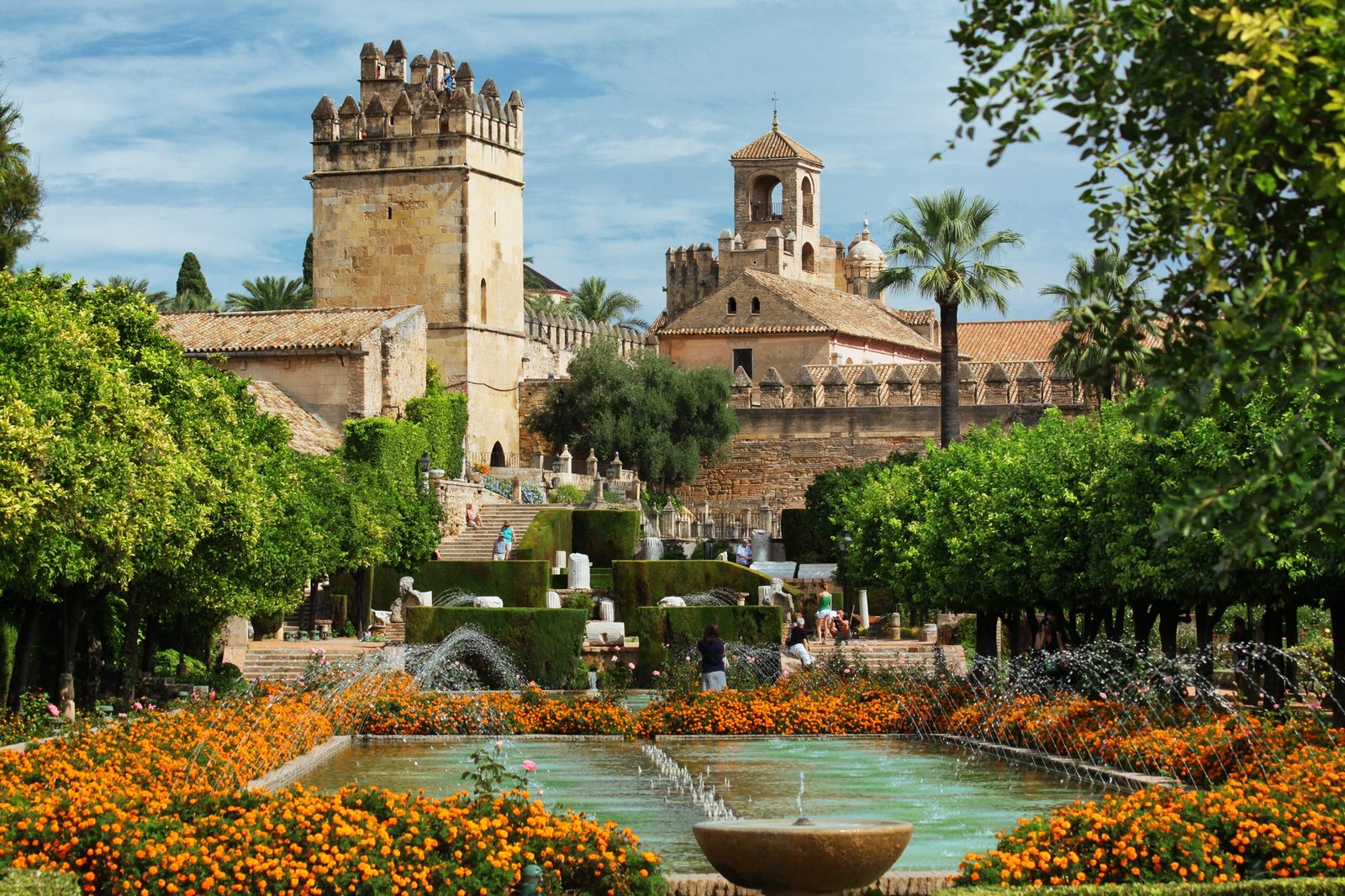
Why this orderTake an early high-speed train south and leave your bags at the hotel. The Mezquita comes first, before the tour groups arrive. Wander from it into the old Jewish quarter for the small synagogue, then on to the gardens of the Alcázar of the Christian Monarchs. End on the Roman bridge as the light goes, with the Mezquita behind you across the river.
Getting aroundHigh-speed train from Madrid-Puerta de Atocha to Córdoba, then a taxi or bus to the old town. On foot after that: the synagogue is a few minutes from the Mezquita, the Alcázar a few minutes more, and the Roman bridge just beyond it.
A mosque begun in 785 under Abd al-Rahman I, with a forest of striped double arches, and a Renaissance cathedral built into its centre after the Christian conquest. Book on the official site.
A small synagogue finished in 1315, its walls covered in carved Mudéjar plasterwork. Free, and a short visit.
The fortress-palace where Ferdinand and Isabella lived for years, best known for its terraced gardens of pools, fountains and orange trees.
The long stone bridge over the Guadalquivir, built on Roman foundations, leading to the Calahorra tower on the far bank. Free, and the best view of the Mezquita.
If the Alcázar is closed: Cross the Roman bridge earlier and visit the Calahorra Tower at its far end, a small museum of life in al-Andalus.
Why this orderTake a morning train to Seville and start with the open spaces. The Plaza de España and the María Luisa park were built for the 1929 exhibition and are free. Follow the river north to the Torre del Oro, then cross the Isabel II bridge into Triana, the old potters' and sailors' quarter, for its covered market and an evening on the far bank.
Getting aroundHigh-speed train from Córdoba to Sevilla-Santa Justa, then a taxi or bus to the Plaza de España. On foot after that: the park is next to the square, the Torre del Oro about 20 minutes on foot along the river, and the Triana market about 15 minutes beyond it, over the bridge.
A huge half-circle of brick and tile designed by Aníbal González for the 1929 Ibero-American Exposition, with a tiled alcove for each Spanish province along its base. Free.
Seville's main park, shaded by palms and orange trees, with pavilions left from the same 1929 exhibition. The easiest place to slow down in the heat.
A twelve-sided watchtower built by the Almohads in the early 13th century to guard the river, now a small naval museum.
Triana's covered food market, built over the ruins of the Castillo de San Jorge, seat of the Inquisition from 1481 to 1785. A good place for lunch on the Triana side.
If it rains: Skip the park and give the time to the Castillo de San Jorge under the Triana market, a free museum in the ruins of the castle.
Why this orderThe two biggest visits are side by side, so do them back to back. Take the first Alcázar slot of the day, then walk across the square into the cathedral and up the Giralda. In the afternoon, lose yourself in the narrow lanes of Santa Cruz and finish at the Casa de Pilatos, a palace of tiled courtyards that most visitors miss.
Getting aroundOn foot all day. The cathedral is across the square from the Alcázar, Santa Cruz begins behind it, and the Casa de Pilatos is about 10 minutes on foot from Santa Cruz.
A royal palace still in use, built by Christian kings in the Moorish style, with courtyards, tiled halls and long gardens. Book ahead; the furnished upper rooms are a separate timed visit.
The largest Gothic cathedral in the world, with Columbus's tomb carried by four kings of arms. The Giralda, a former minaret, is climbed by ramps rather than stairs.
The old Jewish quarter of Seville, a maze of whitewashed lanes and small squares with orange trees. Best walked without a map.
The Seville palace of the Dukes of Medinaceli, its courtyards lined with tiles made by the Pulido brothers in the 1530s and set with Roman and Greek statues.
If the Alcázar is sold out: Visit the Archivo General de Indias, between the Alcázar and the cathedral, a free archive of Spain's empire in a Renaissance merchants' exchange, and try for a later Alcázar slot.
Why this orderThe last day is slower and away from the crowds. Start on the walkway on top of the Setas, the giant wooden parasols over Plaza de la Encarnación, for a view across the rooftops. Walk to the Palacio de las Dueñas, then north to the Macarena basilica, the home of Seville's best-loved Holy Week statue. End in the Alameda de Hércules, a long tree-lined promenade, for a drink on your last evening.
Getting aroundOn foot all day. The Palacio de las Dueñas is a few minutes from the Setas, the Macarena basilica about 15 minutes on foot beyond it, and the Alameda de Hércules about 10 minutes back towards the centre.
Jürgen Mayer's giant timber parasols, finished in 2011, with a market below and a walkway along the top. Roman remains found during the building are shown in the basement.
A late 15th-century palace of the House of Alba, built in the Renaissance style with Gothic and Moorish touches. The poet Antonio Machado was born here in 1875.
The church of the Esperanza Macarena, the weeping Virgin whose night-time procession is among the best known of Seville's Holy Week. Free to enter; cover shoulders and knees.
A tree-lined promenade laid out in 1574, with two Roman columns at its southern end. The place to sit with a drink on your last evening.
If it rains: Trade the Alameda for the Antiquarium in the basement of the Setas, where glass walkways cross Roman houses and their mosaics.
They change by place and season. Many churches and smaller museums close in the middle of the day, and in Andalusia some businesses close in late summer. Check each place before you go, and book a time slot wherever one is offered.
The Royal Palace in Madrid (timed slots on the official site), the Mezquita-Catedral, the Real Alcázar in Seville (only leftover tickets are sold at the door) and Seville Cathedral with the Giralda. Book your trains as early as you can: seats are assigned and fares change with demand, so early booking is usually cheaper.
Renfe (AVE), Iryo and Ouigo run high-speed trains from Madrid-Puerta de Atocha to Córdoba and Sevilla-Santa Justa on the same line. Ouigo tickets are sold online only. Toledo has its own high-speed service from Atocha.
End the week by flying out of Seville, or take the high-speed train back to Madrid on the same line.
Cover shoulders and knees in the cathedrals and the Macarena basilica.
Madrid: around Puerta del Sol or the Barrio de las Letras, walking distance from Days 1 and 2. Córdoba: in the Judería, near the Mezquita. Seville: in Santa Cruz or El Arenal, between the river and the cathedral.
Enough for Madrid, Toledo, Córdoba and Seville at a comfortable pace, because all four sit on one high-speed line. It is not enough to add Barcelona, which is in the opposite direction.
The Alhambra needs its own day and a ticket booked well ahead, and Granada is off this train line. To add it, drop Toledo and give Madrid one day.
Yes, as a long day trip by bus, to see the Puente Nuevo over its gorge. Trade it for Day 7.
The Royal Palace, the Mezquita-Catedral, the Real Alcázar and Seville Cathedral, plus your high-speed trains. Book the Alcázar first: it is the one most likely to sell out.
Spring and autumn. Summer in Seville and Córdoba is very hot, and Holy Week and the April Fair in Seville fill the hotels months ahead.
Place names from Google Maps.
Copy this plan into your own trip notebook. Change anything, add dates later, and invite the people you are travelling with.
Use this plan
By continuing, you agree to the Terms of Service and acknowledge the Privacy Policy.